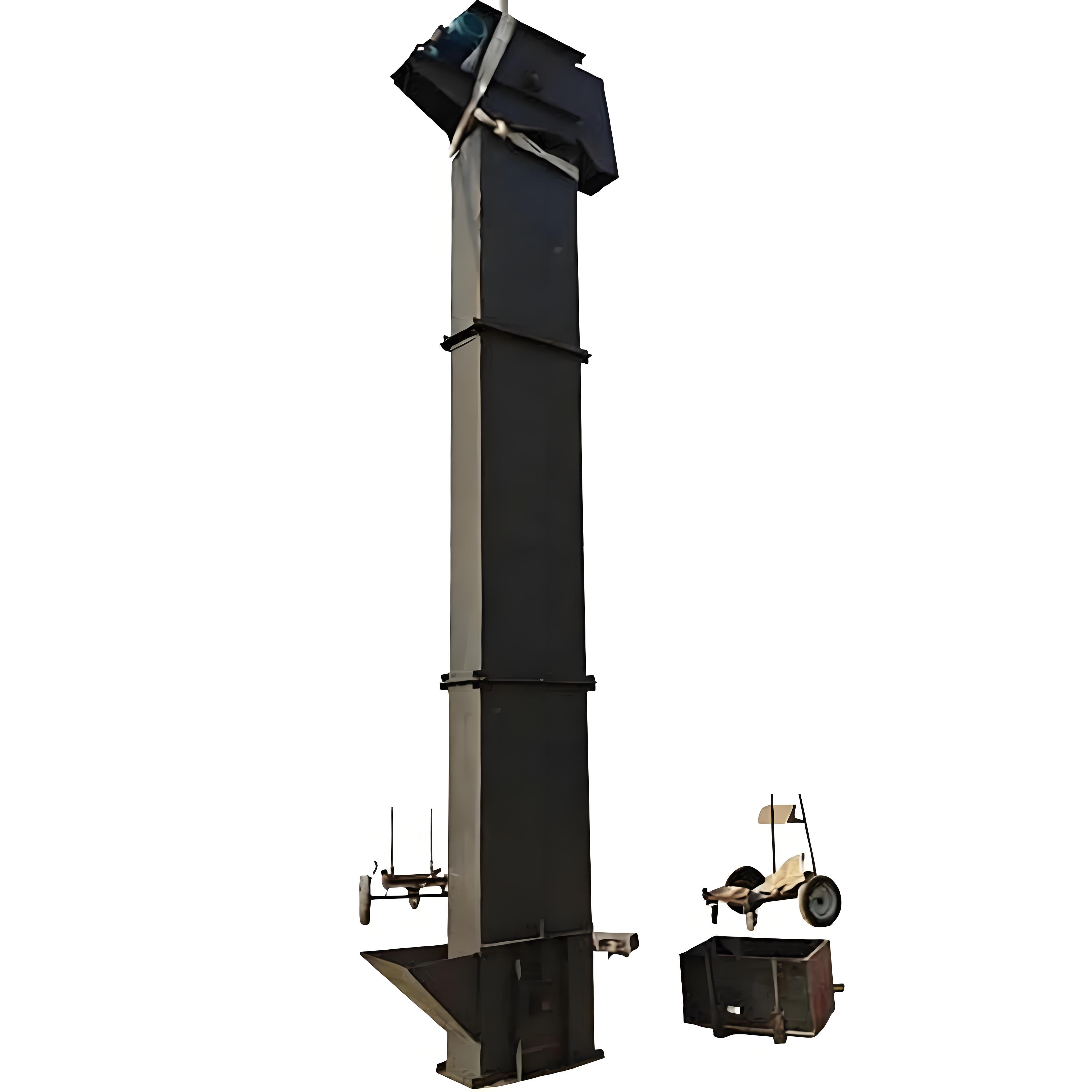
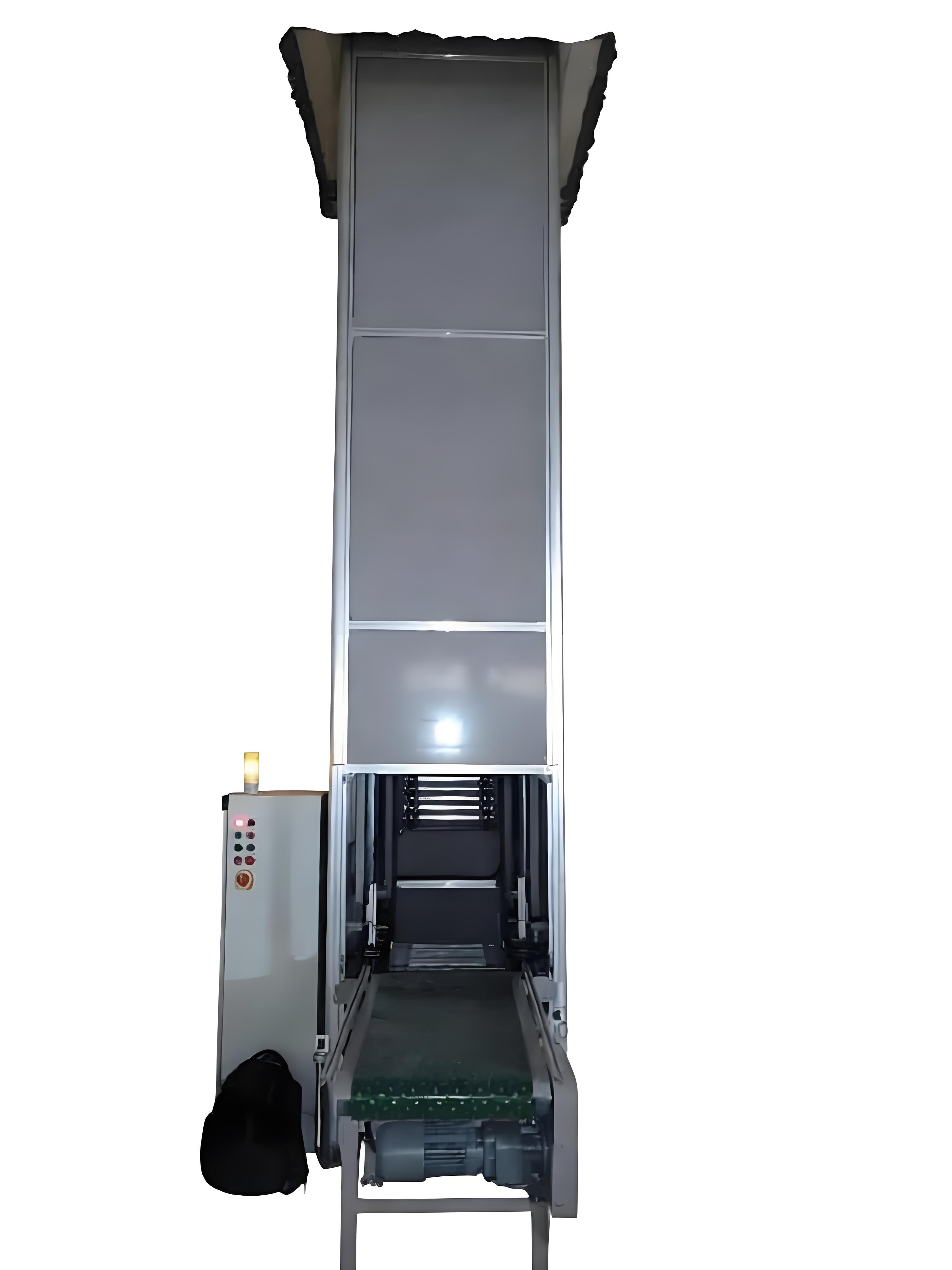
Industrial Vertical Material Conveyor
Mechanical and hydraulic drive options (1,000–10,000+ lb capacities)
Straddle, cantilever, and four-post configurations
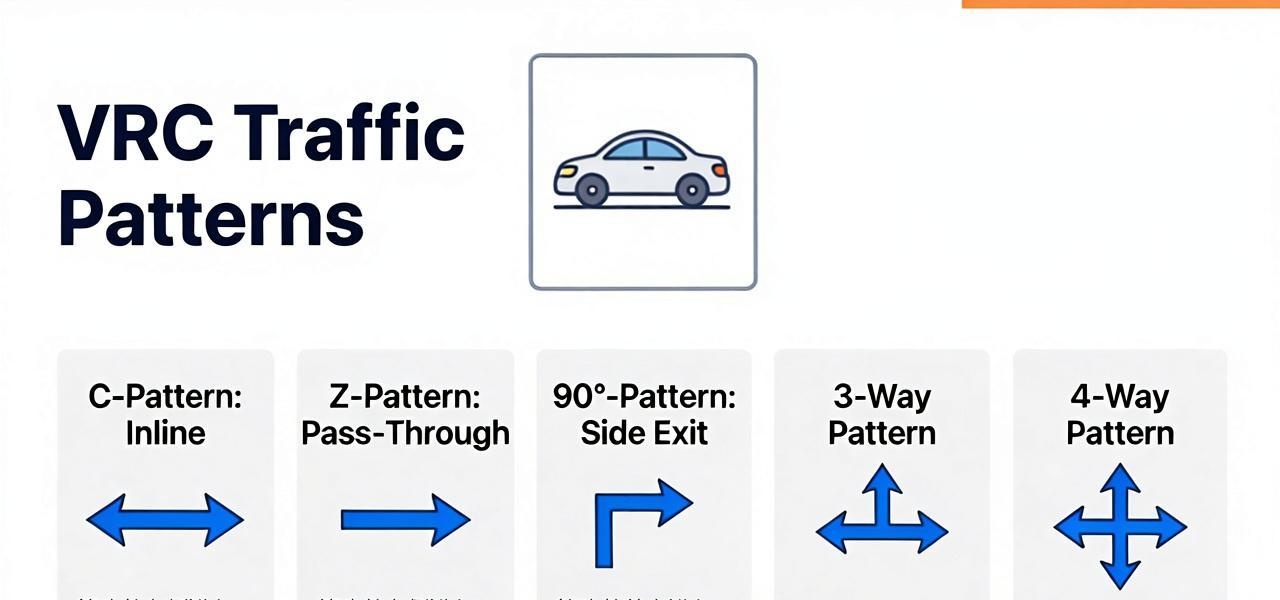
Supports C, Z, 90°, 3-way, and 4-way traffic patterns
Handles pallets, carts, totes, boxes, and bulk materials
Lifting height customizable from 10 to 100+ feet (3 to 30+ meters)
Platform sizes: 36" x 36" to 96" x 96" (custom sizes available)
Travel speeds: 25–60 ft/min standard
ASME B20.1 compliant with emergency drop protection
Suitable for warehouses, manufacturing, ecommerce, and industrial facilities
Lower total cost of ownership compared to freight elevators
Industrial Vertical Material Conveyor – The Complete Guide to Vertical Reciprocating Conveyors (VRCs)
An industrial vertical material conveyor—specifically, a Vertical Reciprocating Conveyor (VRC)—is a material handling system engineered to lift freight, products, and bulk materials safely and efficiently between two or more levels within a facility. By utilizing vertical space, VRCs allow warehouses, distribution centers, and factories to expand their operational footprint considerably—without the massive expense of an addition or renovation.
With decades of engineering expertise in vertical material handling across more than 20 industries—from manufacturing and warehousing to food processing and ecommerce—we've designed, built, and installed VRC systems that have operated reliably for over 20 years in the world's most demanding industrial environments. We've seen firsthand how the right VRC can transform operations—improving safety, increasing throughput, and reducing long‑term costs.
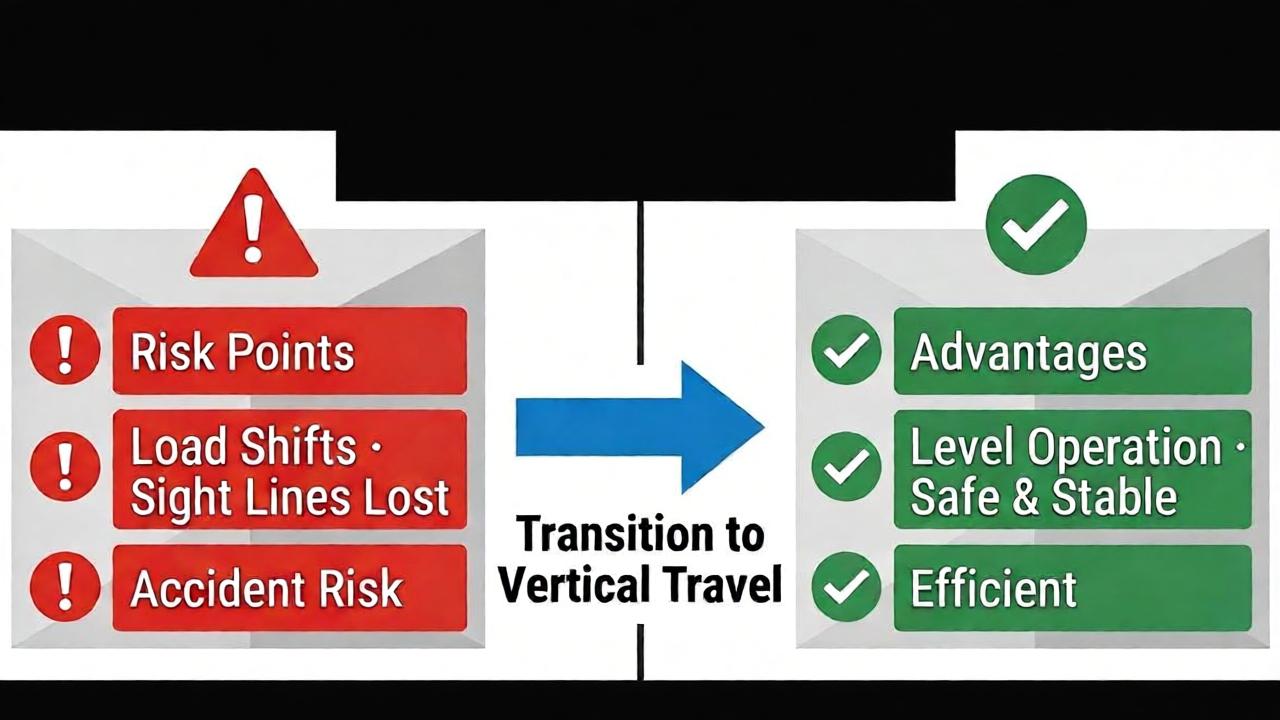
Forklift accidents on ramps remain a persistent safety challenge in multi‑level facilities. Loads shift on inclines, operators lose sight lines at ramp crests, and elevated loads amplify the consequences of minor errors. We design VRCs to remove forklifts from vertical travel entirely—keeping them on level floors where they operate safely.
In this guide, we cover:
✅ What a VRC is and how it differs from freight elevators?
✅ The key advantages VRCs deliver in safety, efficiency, and space optimization.
✅ Mechanical vs. hydraulic drive systems—which one is right for your operation.
✅ Straddle, cantilever, and four‑post configurations with traffic patterns.
✅ ASME B20.1 compliance and critical safety features.
✅ How to select the right VRC for your specific application?
✅ Real‑world case studies and application examples.
What Is an Industrial Vertical Material Conveyor (VRC)?
An industrial vertical material conveyor—commonly known as a Vertical Reciprocating Conveyor or VRC—uses a guided platform or carriage that travels vertically along masts or guide columns. The platform picks up loads at one level, travels to the destination height, and delivers materials to the next floor, mezzanine, or elevated processing station.
We power these systems with electric motors driving either hydraulic cylinders or mechanical chain/cable mechanisms. Our control systems manage the lifting sequence while safety interlocks prevent operation when gates are open or loads exceed capacity. Platform surfaces can be configured with roller conveyors, chain transfers, or turntables for automated load handling and smooth integration with existing material handling equipment.
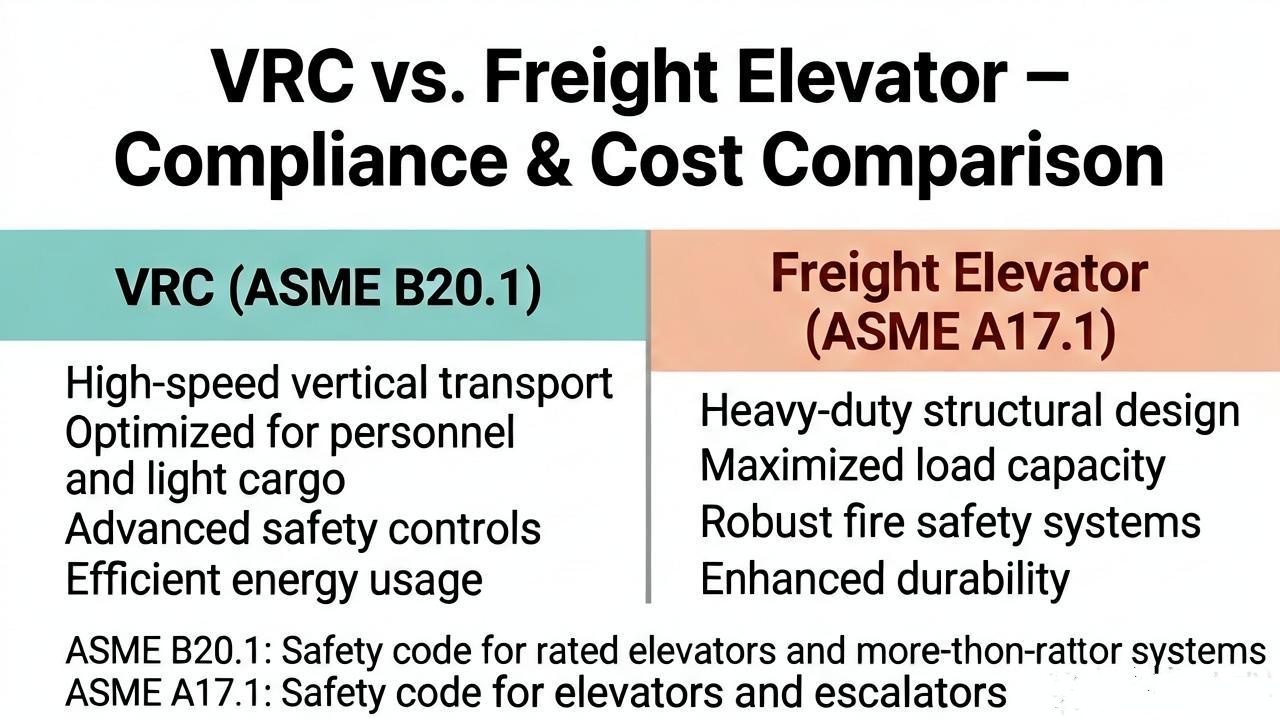
Key distinction: A VRC is not a freight elevator. While both move materials vertically, we build VRCs exclusively for materials—never people—and we design them to ASME B20.1 safety standards for industrial lifting equipment, not elevator codes (ASME A17.1).
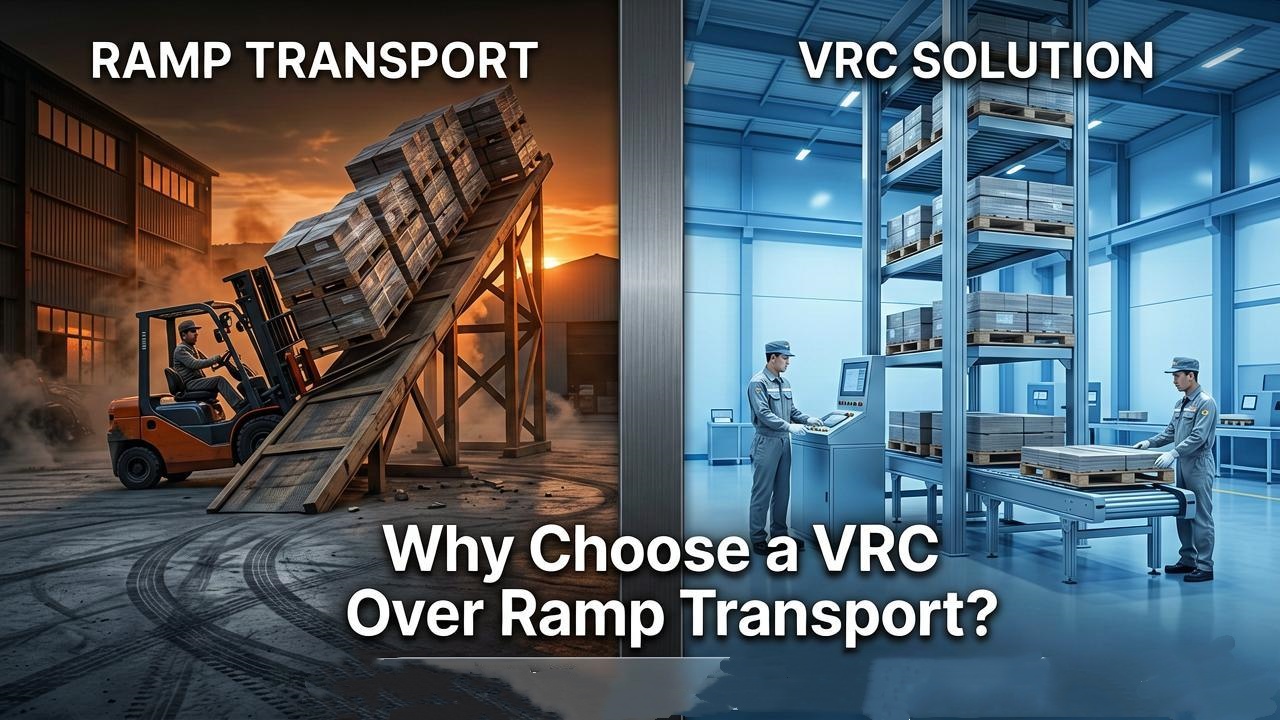
Why Choose a VRC Over Ramp Transport?
Forklift accidents on ramps remain a persistent safety challenge in multi‑level facilities. The physics create real problems—loads shift on inclines, operators lose sight lines at ramp crests, and elevated loads amplify the consequences of minor errors. We design VRCs to remove forklifts from vertical travel entirely, keeping them on level floors where they operate safely. This single change delivers measurable safety improvements.
Additional benefits:
Space Optimization – VRCs maximize vertical space without requiring expensive building additions or renovations. A single VRC can replace thousands of square feet of ramp space.
Cost‑Effective – Compared to freight elevators, VRCs offer significantly lower total cost of ownership—driven largely by less stringent regulatory requirements, as VRCs are not designed to transport people. This results in lower equipment, installation, and long‑term maintenance costs.
Higher Throughput – Our VRCs can handle high cycle rates with lifting speeds up to 2 meters per second. Capable of handling up to 100 kg of boxes, pallets, and other loads, they reach a throughput of approximately 400 cycles per hour.
Real‑World Application – Food Processing Facility
We recently deployed a custom cantilever VRC at a food processing facility to lift 3,500 lb pallets of raw ingredients between a ground‑floor receiving area and a second‑story mezzanine production line. The system operates at 25 cycles per hour, 16 hours per day, and features a platform size of 72" x 72" to accommodate oversized pallets.
Prior to installation, the facility experienced an average of one ramp‑related forklift incident every quarter. Since installation, we've eliminated those incidents entirely and reduced forklift ramp traffic by over 90%. The system has operated 16 hours daily for 18 consecutive months with zero unplanned downtime, handling an average of 175 pallet lifts per day, resulting in an estimated annual savings of $47,000 in accident‑related costs and downtime.
Mechanical vs. Hydraulic Drive Systems
Choosing the right drive system is the first and most critical decision when selecting an industrial vertical material conveyor. Based on our experience with hundreds of installations across more than 20 industries, this choice ultimately comes down to three factors: duty cycle, load weight, and number of levels served.
Hydraulic VRCs
Hydraulic VRCs use fluid pressure for smooth, controlled lifting. We typically recommend them for two‑story applications or mezzanines where quiet operation matters. The hydraulic approach provides inherent load control, protecting sensitive loads. Our hydraulic systems are ideal for moderate load capacities (typically up to 10,000 lbs / 4,500 kg).
We recommend a hydraulic VRC if:
You are lifting loads to a second story or mezzanine.
Your application requires a moderate number of lift cycles per day (under 100 cycles/hour).
You're primarily lifting materials with common dimensions and weights.
Your initial budget is a primary concern.
Mechanical VRCs
Mechanical VRCs use chain, cable, or screw‑driven mechanisms for heavier loads, taller heights, and higher duty cycles. We engineer them for applications where speed, power, and high frequency are top priorities. If you're running continuous production, we typically specify mechanical drives because they scale better. When facilities need three or more levels, especially with heavy loads and tall travel heights, mechanical drive systems handle those requirements more effectively. Our mechanical systems require less upkeep and use less electricity over time.
We recommend a mechanical VRC if:
You need to serve multiple stories or require high vertical travel (over 30 ft / 9 m).
You're lifting exceptionally heavy loads (over 10,000 lbs).
You're running continuous production with high‑duty cycles (100+ cycles/hour).
Long‑term operating costs are more important than initial investment.
Long‑term cost comparison: Based on our experience with hundreds of installations, mechanical systems typically have 30‑40% higher upfront costs but offer 15‑25% lower lifetime operating expenses for high‑duty applications. Hydraulic systems offer lower initial costs but may incur higher ongoing maintenance and energy expenses in continuous‑use scenarios. We help clients calculate the break‑even point based on their specific duty cycle.
VRC Configurations and Traffic Patterns
When choosing a vertical reciprocating conveyor, selecting the right configuration is crucial for optimizing material handling efficiency and ensuring seamless operations. We offer three primary configurations.
Structural Configurations:
Straddle Configuration – The carriage is centered between two vertical guide beams, evenly distributing weight. Supports C and Z loading patterns. Requires more floor space but handles heavy, wide, or asymmetrically‑loaded materials with maximum stability. Delivers consistent performance in high‑volume operations. [Learn more about our straddle VRC systems →]
Case Study: We engineered a custom straddle VRC for a glass plant to lift delicate stainless steel spacer channels—over 2‑story vertical travel, spanning 17 feet, and handling up to 3,500 lbs on an exceptionally wide carriage (over 26 feet). This solution ensured safe, efficient, and precise material flow in a high‑volume window assembly operation, eliminating the previous manual lifting process that had caused multiple product damage incidents annually.
Cantilever Configuration – Guide columns are located on one side of the carriage, leaving three sides open for loading and unloading. We often recommend this for space‑constrained areas. Supports C, Z, and 90° loading patterns, offering maximum flexibility. [Explore our cantilever VRC solutions →]
Case Study: We designed a custom two‑post cantilever VRC for an offshore oil platform application, moving up to 1,500 lbs over 32 feet between the helipad and platform deck. Built for harsh marine conditions with galvanized steel and stainless components, this system has operated reliably in saltwater environments for over 5 years with minimal maintenance.
Four‑Post Configuration – Provides maximum stability for oversized loads and 4‑way access. We specify this for extremely heavy or unusually shaped loads that require support at all four corners. [View our four‑post VRC options →]
Traffic Patterns:
Z‑Pattern (Pass‑through) : Loads enter one side and exit the opposite side—efficient for straight‑through material flow.
C‑Pattern (Inline) : Loading and unloading occur on the same side—ideal for facilities with space constraints.
90‑Degree (L) Pattern: Load enters from the front and exits via the left or right side—flexible for corner installations.
3‑Way and 4‑Way Patterns: Maximum flexibility for complex sortation needs
VRC vs. Freight Elevator – What's the Difference?
The core difference between an industrial vertical material conveyor (VRC) and a freight elevator is that people cannot ride a VRC. By definition, elevators are conveyances designed to transport people vertically. Freight elevators are built (and regulated) for both people and loads. We build VRCs exclusively for freight.
Why this distinction matters for your bottom line:
This distinction dramatically affects the lifetime cost of ownership. Before the 1980s, all vertical conveyors had to comply with the ANSI/ASME safety code for elevators, whether people were allowed to ride on them or not. That created serious barriers for manufacturers—they had to build in redundant safety features designed to protect people, even though no one would ever ride a VRC.
Today, VRCs are recognized as a distinct equipment category under ASME B20.1 (the Safety Standard for Conveyors and Related Equipment), while freight elevators must comply with ASME A17.1 (the elevator code).
What does this mean for your facility? Choosing a VRC over a freight elevator typically saves 30‑50% on installation costs, reduces inspection frequency from quarterly to annual, and eliminates the need for a full shaftway. We've helped clients save an average of $65,000 per installation simply by selecting the right equipment classification from the start.
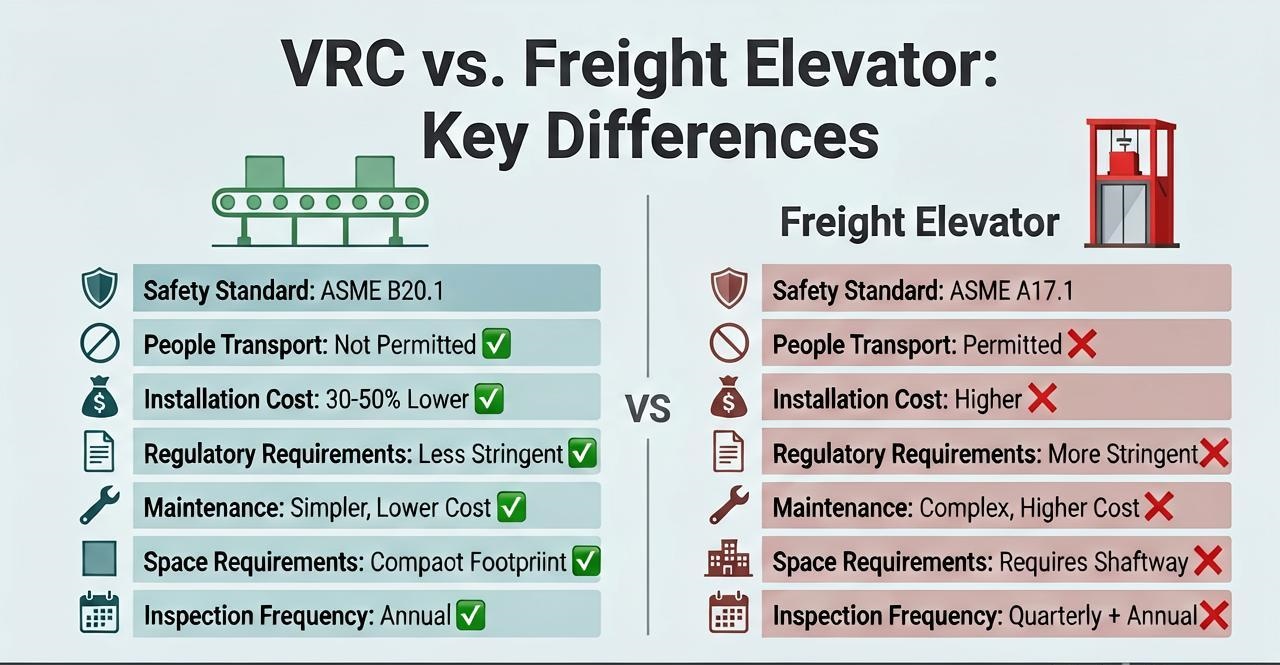
| Factor | VRC | Freight Elevator |
| Safety Standard | ASME B20.1 | ASME A17.1 (elevator code) |
| People Transport | Not permitted | Permitted (operators) |
| Installation Cost | Lower (typically 30‑50% less) | Higher |
| Regulatory Requirements | Less stringent | More stringent |
| Maintenance | Simpler, lower cost | More complex, higher cost |
| Space Requirements | Compact footprint | Requires shaftway |
| Inspection Frequency | Annual (typically) | Quarterly + annual |
Safety Standards and Critical Safety Features
We build all industrial vertical material conveyors in full compliance with ASME B20.1—the Safety Standard for Conveyors and Related Equipment. This standard dictates technical specifications for engineering, building, installing, maintaining, and operating conveyors.
ASME B20.1 compliance requires:
Enclosures at least 96 inches high at all access points to prevent unauthorized entry.
Mechanical interlocks preventing carriage movement unless all safety gates at every level are fully closed and secured.
Electrical position switches confirming gate status before operation—accuracy within ±1/4 inch.
Emergency stop devices readily accessible at each level.
Load rating plates clearly displayed on the equipment.
OSHA regulations applicable:
29 CFR 1910 – General workplace safety standards.
1926.555 – Conveyor safety in construction settings.
1910.147 – Lockout/tagout requirements for maintenance access.
Emergency Drop Protection:
Emergency Cam Catch: A weighted cam mechanism immediately grips the guide rails if it detects a loss of tension in the lifting chains due to breakage. The carriage locks in place, preventing uncontrolled descent—tested to hold 2x the rated load capacity.
Chain Tension Sensors: Monitor lifting chain tension in real‑time to alert the system of potential issues before a component break occurs.
Overload Protection: Prevents operation when load exceeds rated capacity.
Access Control and Position Monitoring:
Mechanical Interlocks: Integrated locks ensure that the carriage cannot move unless all safety gates at every level are fully closed and secured.
Position Sensors: Keep the VRC aligned with the landing floor before interlocks allow gates to be opened for loading.
Warning Alarms: Audible and visual alerts during operation, meeting OSHA requirements.
Lockout/Tagout Compliance: Access controls comply with ASME B20.1 and OSHA standard 1910.147.
How to Select the Right Industrial Vertical Material Conveyor
Selecting the appropriate industrial vertical material conveyor requires careful evaluation of several factors. Based on our engineering experience across hundreds of successful installations, here's what we recommend you consider:
Design Consideration Checklist:
HOW HIGH? – Measure floor‑to‑floor distance precisely. Include clearance above the upper level for overhead obstructions. We customize systems from 10 to 100+ feet (3 to 30+ meters).
HOW OFTEN? – How many cycles per hour? High‑cycle applications (100+ cycles/hour) benefit from mechanical drive systems with robust chain mechanisms.
HOW HEAVY? – Account for the heaviest load you'll ever lift, plus pallet weight. Over‑specifying costs more; under‑specifying creates safety risks. Our standard systems handle 1,000–10,000+ lbs.
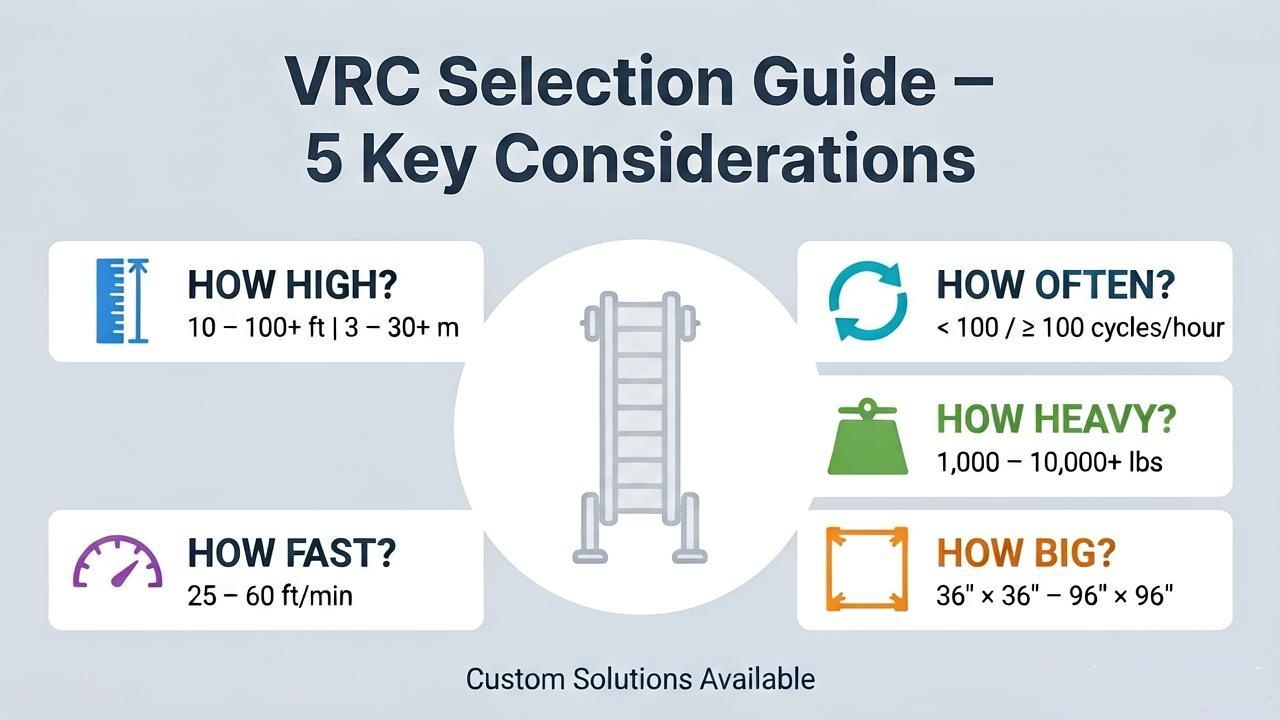
HOW BIG? – What are the width and depth requirements for the carriage? Does the load require additional clearance? Will the carriage need to handle multiple pallets or oversized items simultaneously?
HOW FAST? – What is the required cycle time? Standard speeds range from 25‑28 ft/min, with high‑speed options available up to 60 ft/min.
TRAFFIC PATTERN – Determine how loads will enter and exit at each level. C – Inline; Z – Pass‑through; 90º – Left/Right.
FACILITY LAYOUT – Evaluate available floor space, access points, and integration with existing equipment. Cantilever configurations work best in tight spaces.
ENVIRONMENT – Consider wash‑down areas (stainless steel), outdoor settings (hot‑dipped galvanized), or hazardous locations (explosion‑proof components).
INTEGRATION REQUIREMENTS – Does the VRC need to interface with AGVs, AMRs, roller conveyors, or WMS?
BUDGET – We help clients evaluate both upfront and long‑term costs to determine the most cost‑effective solution.
Common Applications
Warehouses and Distribution Centers – Moving pallet loads, cartons, and totes between mezzanines and floors.Manufacturing Plants – Transporting raw materials, work‑in‑process, and finished goods between production levels.
Ecommerce Operations – High‑speed parcel handling in multi‑level pick modules.
Cement and Mining – Lifting bulk materials such as clinker, limestone, and ores.
Food and Grain Processing – Transporting grains, wood pellets, and other bulk ingredients.
Chemical Industry – Conveying chemical powders and compounds with containment requirements.
Retail and Storage – Moving goods between receiving, storage, and shipping levels.
Frequently Asked Questions
Q: What is an industrial vertical material conveyor?
A: An industrial vertical material conveyor—specifically a Vertical Reciprocating Conveyor (VRC)—is a material handling system that lifts freight and products between multiple levels using a guided platform or carriage, built to ASME B20.1 safety standards.
Q: Can people ride on a vertical reciprocating conveyor?
A: No. We design VRCs exclusively for materials and they are not permitted to transport people. This is what distinguishes them from freight elevators under ASME B20.1 standards.
Q: What is the difference between a VRC and a freight elevator?
A: The core difference is that people cannot ride a VRC. Freight elevators are built and regulated for both people and loads (ASME A17.1), while VRCs are just for freight (ASME B20.1). This results in VRCs having 30‑50% lower installation costs.
Q: Should I choose a mechanical or hydraulic VRC?
A: Based on our engineering experience, we recommend hydraulic VRCs for two‑story applications and moderate duty cycles (under 100 cycles/hour). We recommend mechanical VRCs for multiple stories, heavy loads (over 10,000 lbs), and continuous high‑frequency operation (100+ cycles/hour).
Q: What safety standard applies to vertical reciprocating conveyors?
A: All industrial VRCs must comply with ASME B20.1. This requires 96‑inch enclosures, mechanical interlocks, and electrical position switches. OSHA regulations (29 CFR 1910, 1926.555) also apply.
Q: What types of loads can a VRC handle?
A: Our VRCs handle pallet loads, carts, tools, heavy equipment, raw materials, parcels, and warehouse bins. Capacity typically ranges from 1,000 to 10,000+ lbs.
Q: Can a VRC be integrated with automated systems?
A: Yes. We configure VRCs with roller conveyors, chain transfers, or turntables for automated load handling, and they can integrate with AGVs and AMRs.
Q: How long does a VRC typically last?
A: With proper maintenance, our VRCs operate for 20+ years in industrial environments.
Ready to improve your vertical material handling?
Our engineering team is ready to discuss your specific application requirements—from load capacity and travel height to configuration and integration with existing equipment. Request a quote or schedule a consultation to receive a customized VRC solution tailored to your facility's unique needs.
Products
Hot Modules
locations


headquarters
Address:China,Yanjin county forest park gate to the west 1000 meters north road.