
Bucket Elevator vs Belt Conveyor, Which Is Right for Your Application?
Monday October-12 2026 13:39:11
Bucket Elevator vs Belt Conveyor: An Overview
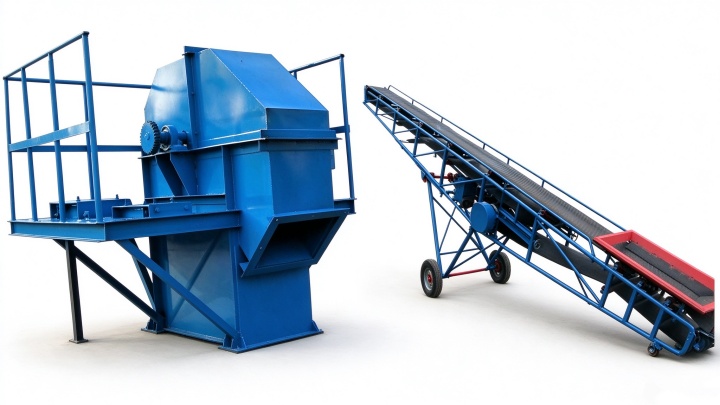
Bucket elevators and belt conveyors are two of the most common solutions for moving bulk materials in industrial settings. A bucket elevator is designed for vertical lifting, using buckets mounted on a belt or chain to carry material upward in a compact, enclosed system. It is widely used for free-flowing materials such as grain, fertilizer, and minerals. A belt conveyor, by contrast, moves material horizontally or at a slight incline on a continuous belt. It excels at long-distance, high-capacity transport and is a standard choice for sand, gravel, coal, and similar bulk solids.
While both systems can handle a wide range of materials, they differ significantly in conveying direction, capacity, footprint, and material compatibility. The comparison below outlines the key differences, followed by five decision factors to help you choose the right system for your application.
How They Work
Bucket Elevator
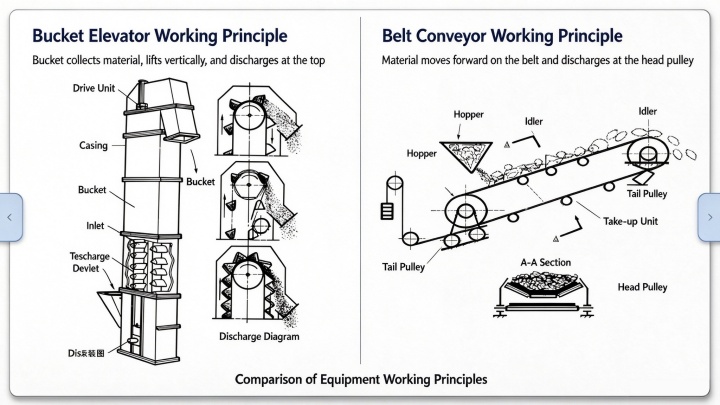
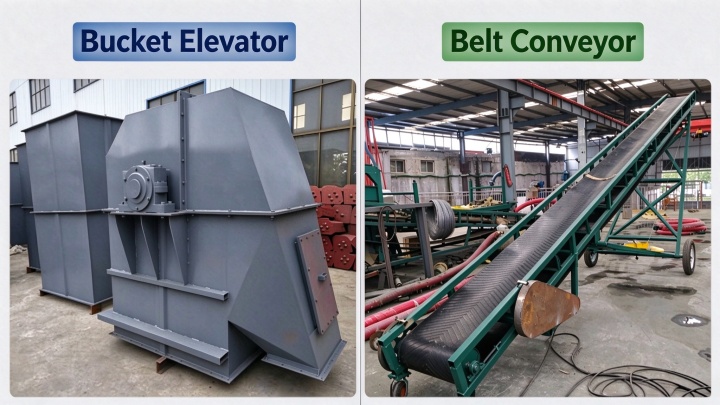
A bucket elevator lifts bulk materials vertically using buckets mounted on a belt or chain. It scoops material at the boot, carries it upward, and discharges at the top by centrifugal force or gravity. It is compact and ideal for free-flowing materials such as grain, fertilizer, and minerals.
- Low friction: Material is carried, not dragged, so power consumption is low.
- Compact: Far less floor space than an inclined belt system.
- Sealed: Dust emissions are minimized; aspiration can be connected.
Belt Conveyor
A belt conveyor moves material horizontally or at a slight incline on a continuous belt. It is the efficient choice for long distances and high capacities, handling grain, fertilizer, sand, gravel, and more.
- Long distance: Single units can span kilometers.
- Gentle handling: Minimal material degradation, ideal for fragile products.
- Lowest cost per ton-meter: Approximately $0.003–$0.015 per ton-meter.
Quick Comparison: At a Glance
| Feature | Bucket Elevator | Belt Conveyor |
|---|---|---|
| Primary Direction | Vertical (up to 90°) | Horizontal to ~20° incline (30° with ribbed belt) |
| Capacity Range | 5–1,000 TPH | 50–20,000+ TPH |
| Max Single-Unit Length | Limited by lifting height (typically ≤80 m) | Up to 15 km |
| Footprint | Very compact; 1–2 m² base for 10 m lift | Requires significant horizontal projection (38 m run for 10 m lift at 15°) |
| Maintenance Intensity | Moderate; multiple moving parts | Low to moderate; simpler mechanics |
| Energy Efficiency (Vertical) | High (30 kW to lift grain 30 m) | Lower (72 kW for equivalent lift via inclined chain) |
| Material Temperature | Up to 400°C (chain type) | Limited by belt material |
| Dust Containment | Good (enclosed casing) | Moderate (open design, dust covers available) |
| Best For | Vertical lifting of free-flowing bulk solids | Long-distance, high-capacity horizontal transport |
5 Key Decision Factors
Conveying Direction and Path
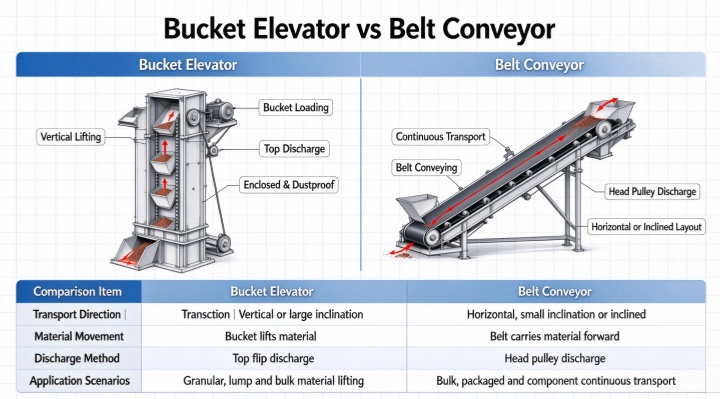
Belt conveyors are horizontal to mildly inclined, normally up to 18° (35–45° with cleated belts, but with lower capacity and higher maintenance). Bucket elevators are designed for vertical lifting and use far less floor space.
Rule: For vertical lift over 15 m and horizontal distance under 100 m, choose a bucket elevator.
Material Characteristics
Free-flowing granules/powders (grain, plastic pellets, cement): bucket elevator for vertical lift; belt conveyor for horizontal or low-angle conveying.
Abrasive materials (quartz sand, ore, clinker): belt conveyor with wear-resistant belt; scraper belt for fibrous or sticky materials.
Hot materials (clinker, lime, coke): chain bucket elevator up to 400°C; belt bucket elevator generally below 130°C.
Fragile materials (feed pellets, seeds): both can work; belt conveyor is gentle, bucket elevator reduces friction.
Sticky or moist materials: avoid bucket elevator; use belt conveyor with scraper.
Capacity and Throughput
Bucket elevators range from 5–20 TPH to over 600 TPH. Belt conveyors excel above 500 TPH over long horizontal distances.
Rule: Below 300 TPH vertical lift → bucket elevator. Above 500 TPH horizontal transport → belt conveyor.
Space and Layout
A belt conveyor lifting material 10 m at 15° needs about 38 m of horizontal run. A bucket elevator needs only 1–2 m² at the base and goes straight up. For brownfield projects, this is often the deciding factor.
Environment and Safety
Dust: Bucket elevators are fully enclosed and easier to contain dust. Belt conveyors are open but can be covered.
Explosion risk: Both must comply with ATEX or NFPA standards for combustible dust.
Safety: Bucket elevators require a backstop; dust-generating materials need a closed casing and dust collector.
Noise: Belt bucket elevators are quieter than chain type; belt conveyors are quietest for horizontal transport.
Application Scenarios
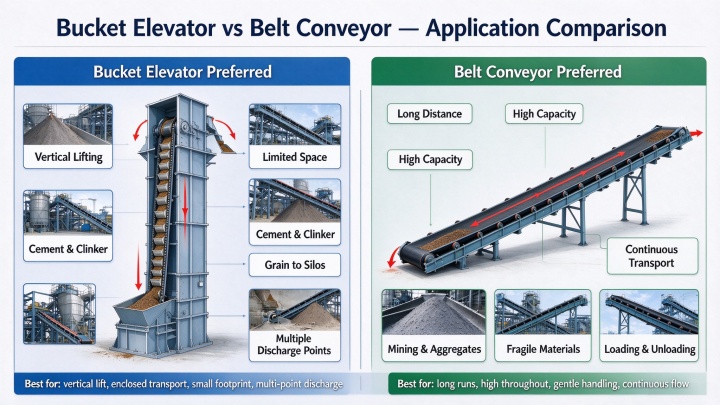
Choose Bucket Elevator For:
- Cement plants: raw meal, clinker, cement, 70–480 TPH
- Grain handling: elevating into silos, up to 50 TPH and higher
- Fertilizer: urea, DAP, compound fertilizer
- Chemical processing: corrosive or abrasive powders
- Space-limited plants and brownfield expansions
- Multi-discharge to several destinations from one lift
Choose Belt Conveyor For:
- Long-distance transport over 100 m
- High-capacity horizontal transport over 500 TPH
- Mining and aggregates: ore, sand, gravel
- Fragile materials requiring gentle handling
- Loading/unloading along a continuous path
Hybrid Systems
Many plants combine both: bucket elevator for vertical lift and belt conveyor for horizontal distribution. One case uses a 240 m, 14° belt conveyor feeding a bucket elevator, which feeds a silo.
The choice is not about which is better, but which fits your application. Bucket elevators win for vertical lifting with minimal footprint and high energy efficiency. Belt conveyors win for long-distance, high-capacity horizontal transport at the lowest cost per ton-meter. Most bulk handling facilities benefit from using both together.
Next step: Evaluate your requirements against the factors above. Contact our engineering team for selection support and a detailed quotation.
Recommend Product
Chain Type Bucket Elevator
Belt Type Bucket Elevator
Multi-discharge bucket elevators
Related Information
Products
Hot Modules
locations


headquarters
Address:China,Yanjin county forest park gate to the west 1000 meters north road.